Human Writing is a Skill for drafting and revising Chinese prose, checking source material and paragraph progress before wording and rhythm. To install it, follow the upstream repository with a Skill-capable agent or copy the complete skill folder; use the lite text in a chat interface that cannot load Skills. The upstream example below illustrates a wording change, with our annotations showing what still needs review. See the official README and lite rules.
An upstream wording example, with editorial annotations
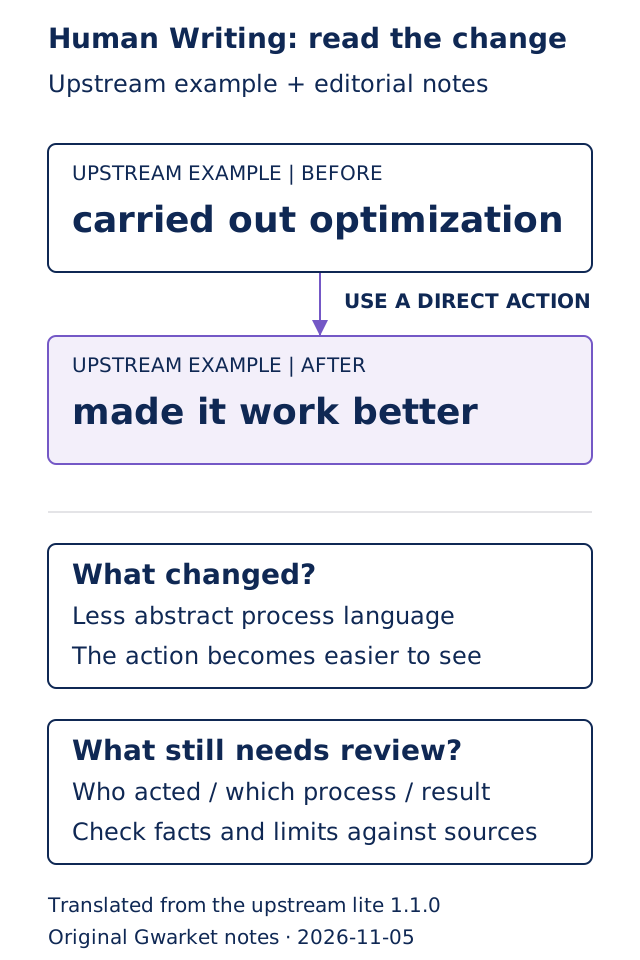
The brief before-and-after wording is translated from the upstream lite rules. Diagram and annotations by Gwarket; verified November 5, 2026. The English translation explains a Chinese-writing rule.
The revision makes an action more direct. A complete sentence still needs a person, the process changed and a supported result. The core rules therefore treat material, paragraph development and Chinese rhythm as separate concerns.
Our first judgment: when a draft lacks substance, add evidence or narrow the topic before polishing. A project description with three abstract benefits still needs actions, constraints and outcomes. Changing its tone cannot supply those missing facts. This applies the upstream material-first approach to workplace writing.
When is it useful?
| Situation | How to use it | What to review |
|---|---|---|
| A sourced Chinese draft | Remove repetition and revise order or phrasing | Preserve facts, limitations and the author's judgment |
| Interview or project material | Supply sources and protected details before drafting | No invented quotes, inner thoughts or personal experience |
| Fluent but repetitive prose | Ask what each paragraph adds | Keep necessary reasoning when shortening |
| Contracts, formal notices or technical specifications | Apply the required genre first; use general rules selectively | Preserve precise terms, conditions and formatting |
The project separates factual from fictional writing and gives explicit user and genre requirements priority over generic prose rules. See core rule precedence and factual-writing boundaries.
Our second judgment: protect the information that must stay precise before making a passage conversational. A workplace notice still needs its owner, date and exceptions. An author's deliberate rhythm need not become a uniform sequence of short sentences. Define acceptance criteria before asking for a more human voice.
Installation: full Skill or lite?
Start from KKKKhazix/human-writing. Give the repository URL to an agent that supports Skill installation and ask it to follow the upstream instructions; a chat interface does not automatically imply Skill loading.
For a manual setup, obtain the source from Releases, or copy the repository's complete human-writing folder into a directory supported by your client. The README lists:
~/.agents/skills/human-writing/
Keep SKILL.md, references/, scripts/ and dist/ together. Check your client's discovery and activation rules separately. See the upstream installation instructions.
| Option | Use it when | Scope |
|---|---|---|
| Full Skill | Your agent loads Skills and task-specific reference files | Entry rules, genre references, lite text and checker |
| Lite | Your chat interface cannot install a Skill | Compact rules supplied with the task; no automatic access to the full references or script |
The lite file is designed to be pasted with a writing request. Supply sources, audience and protected content alongside it.
A task brief that protects the content
This is a Gwarket task template, rather than an upstream output:
Use human-writing to revise this Chinese draft.
Audience and publishing context:
Allowed material and sources:
Facts, figures, quotations and limitations to preserve:
Voice to retain:
Identify material gaps first. Do not add experiences or unsupported outcomes.
Make the changes easy to compare with the source draft.
Review the facts and substance, then paragraph progress, then wording and rhythm. This is our suggested work sequence; the upstream revision checklist provides more detailed passes.
The included scripts/check_prose.py flags defined violations, warnings and selected text statistics; it does not rewrite the draft. A clean rule report does not establish factual accuracy or good style. See the checker source.
Version, cost and limits
- Version fact: the latest formal release at verification was v1.1.0, published August 5, 2026. This guide pins documentation to
4fda173f3fef. The update adds lite and shifts some checks from literal phrases to rhetorical patterns. See the release and changelog. - License fact: the repository uses MIT. Model, chat-service or API charges are separate.
- Language scope: the current main branch targets Chinese writing. English-translation PR #9 remained open at verification; it is not a merged English-writing feature.
- Content responsibility: the rules cannot provide real experience or replace fact-checking. The upstream core and factual-writing rules restrict invented user experience; this guide makes no AI-detector guarantee.
A community report to interpret carefully
In Issue #8, one user reports sparse psychological description during long-form fiction. The report lacks enough prompt, sample and version detail to generalize. The core rules explicitly allow fictional inner thoughts and plot. Specify the narrative elements that must remain and check for over-editing instead of treating a generic style rule as the standard for every work.
Next steps
- Distinguish Skills, prompts, tools and subagents: decide whether the missing piece is reusable guidance or a tool capability.
- Check AI facts, inferences and judgments: verify that a smoother revision still has evidence.
- Check data and authority boundaries: decide what work material can be sent to an external service.
Sources and verification date
Verified November 5, 2026. Release status comes from GitHub; documentation is pinned to main commit 4fda173f3fef7fb808f3eba991eeb2528ea4b189. The release tag points to cd879d22c858, a distinct commit.
- README: purpose, installation and layout.
- Core rules, factual writing and revision checklist.
- Lite rules: original short wording example.
- v1.1.0, checker and MIT.
- Issue #8 and PR #9: an attributed report and an unmerged proposal.