The useful signal in this snapshot is not which AI product is "most popular." It is what people ask next after encountering a name: price or plan, how to get started, what it is, and whether Chinese is available. Across Google search suggestions for 28 preselected seeds, explaining a tool, its cost, and its entry point is usually a more defensible next step than ranking products.
At 2026-11-08T00:45:30.885Z, Gwarket collected Google Autocomplete suggestions for 28 AI-related seeds in the Taiwan locale (zh-TW / TW). The collection contains 7,248 raw rows and 7,237 suggestions after global cross-seed deduplication. It is not search volume, user counts, market share, or a product ranking. It is a dated snapshot of phrases returned by the search box under one fixed sampling method.
Do not treat search suggestions as a market ranking
Google search suggestions are input prompts. They do not state how often a phrase was searched, who searched it, or why. An observation that 18 seeds matched a rule cannot become a claim of "18 times the demand." The list also mixes products, companies, and concepts, including ChatGPT, Claude, OpenAI, Anthropic, MCP, and AI agent. They are not one comparable tool category and do not belong on a single popularity chart.
That constraint determines the appropriate use of the data. It can help identify questions a content entry point should answer first; it cannot determine market size or support a claim that a trend is rising. Only a later collection using the same seeds, locale, collection method, and classification rules could compare change under the same method. One collection date does not establish a direction of change.
The top ten suggestions repeatedly point to "make it usable first"
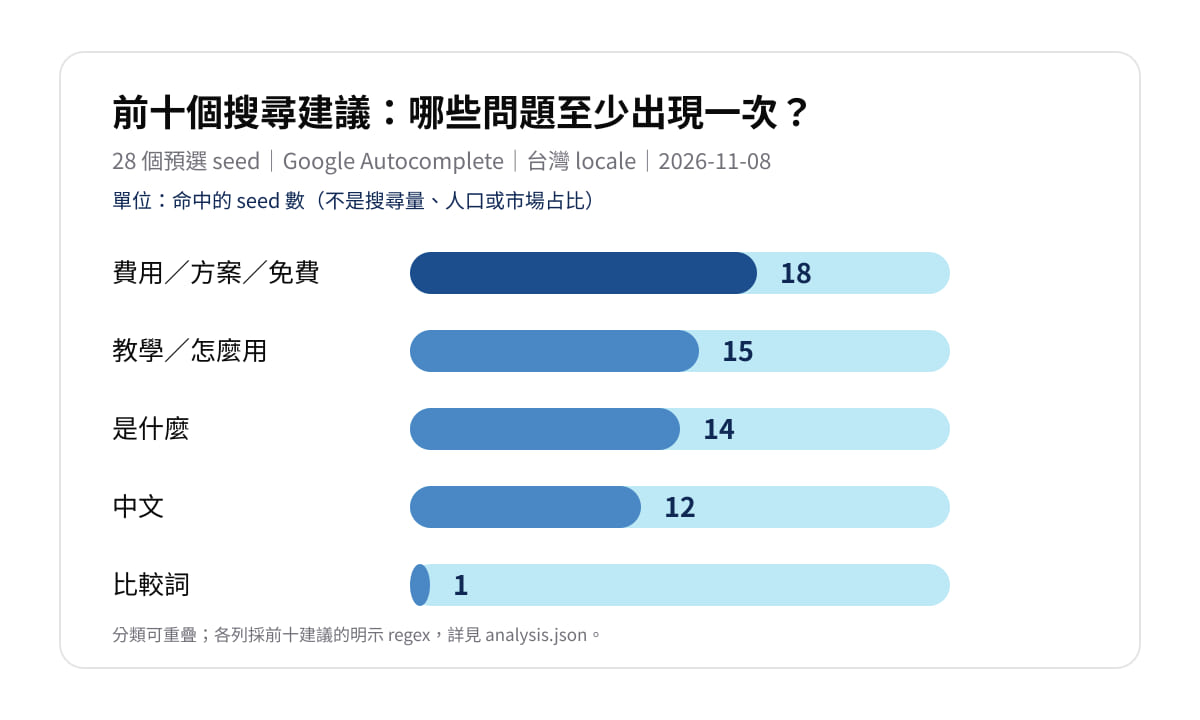
For reproducibility, this analysis checks only the first ten suggestions for each seed + " " query and records whether an explicit regex matched at least once. Categories overlap, so the rows are neither mutually exclusive nor proportions of all suggestions.
| Explicit Chinese-language category label | Seeds with a match in the top ten | Exact matching terms in the collected Chinese-language data | English gloss (translation only, not English search data) |
|---|---|---|---|
| 費用/方案/免費 | 18/28 | 費用、方案、免費、價格、price、pricing、cost、free、plan | price / plans / free |
| 教學/怎麼用 | 15/28 | 教學、怎麼用、how to、tutorial | tutorial / how to |
| 是什麼 | 14/28 | 是什麼、what is | what it is |
| 中文 | 12/28 | 中文 | Chinese language |
| 比較詞 | 1/28 | 比較、差別、vs、versus | comparison terms |
This does not determine which category "is searched most." It answers a narrower question: for how many seeds did a first-screen suggestion contain at least one term from a stated category? A different rule scope can produce a different result. The explicit rules above let readers rerun the attached inputs or substitute a rule, provided they compare definitions before comparing outcomes.
Examples show which question an entry page should answer
ChatGPT's top ten include the raw Chinese query strings chatgpt 費用, chatgpt 方案, and chatgpt 中文; Claude includes claude 中文, claude 方案, claude 費用, and claude 是什麼. The Chinese portions may be glossed as price, plan, Chinese language, and what it is, but those glosses are translations rather than English search observations. An entry page for this kind of query should not only explain features. It should also state when plan information was checked, link to the official entry point, and identify which product surface determines Traditional Chinese support.
Codex's top ten include Chinese query strings for what it is, download, CLI, tutorial, and price: codex 是什麼, codex 下載, codex cli, codex 教學, and codex 費用. Claude Code includes claude code 教學, claude code 費用, claude code cli, claude code install, claude code 下載, claude code 安裝, and claude code 價格; Gemini CLI includes gemini cli 教學, gemini cli 安裝, gemini cli 是什麼, gemini cli 費用, and gemini cli 安裝 windows. These strings support the narrower editorial judgment that installation, entry points, tutorials, and cost deserve early coverage. They do not support a claim that most people in Taiwan are still at the installation stage or that any product is growing.
Under the narrow comparison-term rule, only ChatGPT Work matched, with the raw query examples chatgpt work codex 差別 and chatgpt work vs codex. This is a signal to consider a comparison page, not a market conclusion that comparison demand is low. Comparison intent may use terms such as recommendation or alternative, or a completely different construction; those patterns were not part of this top-ten comparison rule.
Antigravity's top ten repeatedly include antigravity a1. The same-name noise means a completion cannot automatically be assumed to be about one AI product. This report records that ambiguity risk only. It does not extend it into a new investigation, nor does it count the string as evidence about a product feature or demand.
What 7,237 deduplicated suggestions can and cannot do
The full collection is not limited to the top ten. For every seed, it also collects suggestions for seed + " " + a..z. That yields 7,248 raw rows and 7,237 distinct suggestions after deduplication. A separate set of rules over the full list finds 343 rows for the Chinese-labeled category 價格與方案 (price and plans), 283 for 比較與選擇 (comparison and selection), 168 for 安裝與下載 (installation and download), 149 for 操作與教學 (use and tutorial), 111 for 排錯與限制 (troubleshooting and limits), and 58 for 登入與帳號 (sign-in and account).
These counts are an index for locating possible long-tail topics, not a mutually exclusive distribution. One suggestion can match multiple rules, and coverage changes with both seed selection and alphabet expansion. The labels are English glosses for the original Chinese category names; they do not convert the dataset into English-language search data.
For a tutorial, the better order is not to turn all 7,237 phrases into pages. First choose a product entry point that already exists or can be verified. Then answer, in order: what it is, where to start, where to check cost or plans, and the first small action whose result can be checked. Only then use the full list to locate a specific confusion—installation, sign-in, limits, or comparison—and confirm that official documentation can support a separate page. This treats suggestions as topic hypotheses rather than pretending they prove demand volume.
Three checks sit between a phrase and a tutorial
First is a semantic check. Autocomplete places possible continuations together. A Chinese query containing 下載 (download) may seek an official installer or an unofficial repost; 免費 (free) may ask about a plan or try to avoid payment. The list can raise a question, but cannot answer it in advance. When preparing a topic, retain the raw query and use official documentation to establish the product surface, operating system, plan, and date.
Second is a page-boundary check. Codex 教學 (Codex tutorial) and Codex 費用 (Codex price) can share navigation, but they do not necessarily belong in one long page. The first needs starting steps and a checkable result; the second needs verifiable plan conditions and an update date. Likewise, chatgpt work codex 差別 expresses comparison intent and cannot be replaced by a generic product introduction. Decide what the reader must accomplish before choosing an entry page, task tutorial, price page, or comparison page. That prevents dataset vocabulary from becoming a site architecture by accident.
Third is a freshness check. Search suggestions contain no product version, price, or official support scope. Before any such information enters a published body, it must be checked again against primary sources on the publication date. If support is unavailable, a page can say to consult the official page; it should not fill the gap with vague inference. That is why this report stores the raw data, classification rules, and editorial judgment separately: data can be rerun and judgment can be reviewed, but neither should impersonate the other.
The useful reader outcome is not a precise-looking league table. It is the ability to return to the raw phrases, inspect the classification rules, and see which concrete question a subsequent tutorial is meant to answer.
Method, limits, and data downloads
The collection date is 2026-11-08, with recorded collection time 2026-11-08T00:45:30.885Z. The locale is zh-TW / TW. The 28 source seed queries are notebooklm, ai agent, chatgpt, gemini, cursor, n8n, codex, github copilot, sora, midjourney, claude code, mcp, felo, chatgpt work, anthropic, antigravity, canva ai, gamma ai, claude, opencode, gemini cli, manus, nano banana, openai, copilot, perplexity, grok, and deepseek. The method is Google Autocomplete for each preselected seed plus a space, and for each seed plus a space plus a through z. Each seed has approximately 237 to 268 raw rows, a range produced by the sampling limit and return behavior; it cannot compare product popularity. Google can change results over time, geography, and system behavior. This dataset also does not cover every AI name, every language, or every query form.
The reproducibility files are raw-suggestions.json (complete raw suggestion rows), seed-counts.csv (raw and distinct counts by seed), and category-rules.json (full-list classification rules). The top-ten regexes and matching seeds are recorded in analysis.json. Any download or citation should retain the collection date, locale, seed list, and limitations together.
Original diagram: Gwarket / Aaron Huang · CC BY 4.0 ·