Choose a first AI task with small inputs, a result you understand, and a way to check it against the source. Start with a summary of a fictional event notice, comparison fields from public information, or action items from a synthetic meeting excerpt. Treat the output as a first draft and review it before deciding to revise or deliver it.
Choose one bounded piece of work
Preparing a customer proposal includes understanding the customer, checking evidence, choosing claims, writing, building slides and making external commitments. Begin with one visible part:
| Work that is too broad | A smaller starting point |
|---|---|
| Finish a customer proposal | Suggest three outlines from a fictional product brief |
| Decide whether to buy a tool | List five questions to compare using public feature pages |
| Process a whole meeting | Separate possible decisions, actions and unknowns in a synthetic excerpt |
| Change the whole website | Read a practice folder and explain each file's purpose |
Our first judgment: choose by reviewability before apparent simplicity. A short email can contain a mistaken commitment, while a sourced classification table may be easy to check item by item. Keep the inputs, output and stopping point visible before expanding the scope.
Four checks for a good first task
These are Gwarket's teaching checks, rather than an official product classification.
- Small, safe material. Use public, synthetic or non-sensitive input; reproduce the exercise with synthetic content where possible.
- A first-draft output. Ask for a summary, classification, rewrite direction, comparison fields or open questions. Retain the final judgment.
- A result you understand. Know what would be useful and how to identify missing, incorrect or added content.
- A review method. Compare with the source, recalculate a value or involve an appropriate reviewer. Asking the AI to confirm itself is not sufficient.
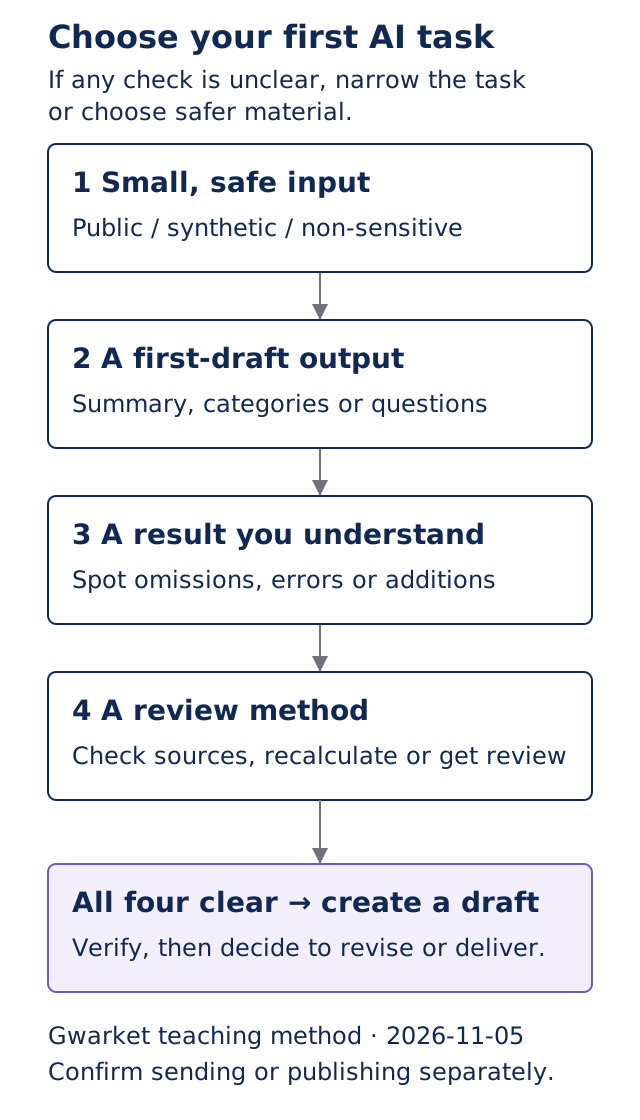
Original Gwarket task-selection diagram, November 5, 2026. The four checks are a teaching method, rather than a capability or safety guarantee.
Reviewable does not mean you must be an expert
If you write a fictional event notice and ask AI for a participant checklist, you can compare the dates, place and instructions with the original. You can spot invented fees or contact details. That is a concrete review method.
If the critical judgment is outside what you can verify, start with organizing evidence or listing questions instead. A final contract, major purchase or consequential personal decision is unsuitable as the final deliverable of a first exercise.
OpenAI's accuracy guidance warns that confident answers can still be wrong. Its ChatGPT Work instructions ask users to supply materials, constraints and review criteria, then inspect the result. These are product-use guidelines, not a guarantee of correctness.
What should you do with an AI-drafted memo?
Treat it as a first draft and verify it before sending. Apply the same reviewability checks to the memo. OpenAI likewise advises checking important information and references rather than treating generated text as a final source. See the official accuracy guidance.
| Check | Review method |
|---|---|
| Names, dates, numbers and quotations | Compare with the source; recalculate when needed |
| Facts, proposals and unresolved items | Check that a suggestion has not become a decision or an unknown a commitment |
| Important conclusions and references | Open the original source and confirm version and context |
| Recipients, purpose and sharing scope | Confirm suitability for the audience and your authority to share |
For example, a note that says “discuss the budget on Friday” must not become “the budget was approved on Friday.” This is a fictional Gwarket example illustrating a meaning check, rather than a real meeting or product output.
Our second judgment: drafting a memo and sending it are separate decisions. A complete-sounding draft still needs factual, decision-status and sharing review. Remove unsupported content, mark it for confirmation or ask the appropriate owner; confident wording does not establish approval.
Fill in a first AI task selection card
Choose work you expect to encounter and reproduce it with public, synthetic or non-sensitive material.
| Field | Example |
|---|---|
| Small piece of work | Turn a fictional event notice into a reminder checklist |
| Material supplied | One text file without real contact details |
| First draft wanted | Bullets that add no facts beyond the source |
| Review method | Compare every date, location and instruction |
| Actions requiring separate confirmation | Deciding to cancel the event or sending anything to participants |
Then ask:
- Can I reduce the input to one or two small files or a short passage?
- Can I identify something the first draft omitted, misstated or added?
- Would this task send, publish, pay or make another external change before I review it?
Yes to the first two and no to the third makes this a practical starting scope. If an answer is unclear, narrow the task, use safer material or arrange an appropriate reviewer.
OpenAI's account of how its teams use Codex recommends well-scoped engineering work. That is an engineering practice; the four checks and selection card here are our cross-product teaching method.
How do you know the exercise is complete?
Keep the source and first draft. Mark what is correct, needs a revision or remains unconfirmed. The useful outcome is explaining what the AI used, what it returned, what needs changing and when to stop; the first attempt need not be perfect.
Before using real work material, confirm organizational rules, data scope and permissions. Continue with a reviewable first Codex task, or revisit Codex permissions if folder, editing or network boundaries remain unclear.
Next steps
- Your first reviewable Codex task: turn the selection card into inputs, instructions and an output.
- Review AI meeting notes: separate decisions, actions and unknowns.
- Check data and authority boundaries: confirm scope before supplying real material.
Sources and verification date
Verified November 5, 2026.
- OpenAI: Does ChatGPT tell the truth?: possible errors, drafts and verification of important information.
- OpenAI: ChatGPT Work and Codex: inputs, constraints, review criteria and progress review.
- OpenAI: How OpenAI uses Codex: bounded engineering tasks; historical interface names are not presented here as universal current instructions.
The four checks, task card, memo checklist and fictional examples are Gwarket's teaching and editorial judgments. Apply them alongside the authority and organizational requirements for your work.